
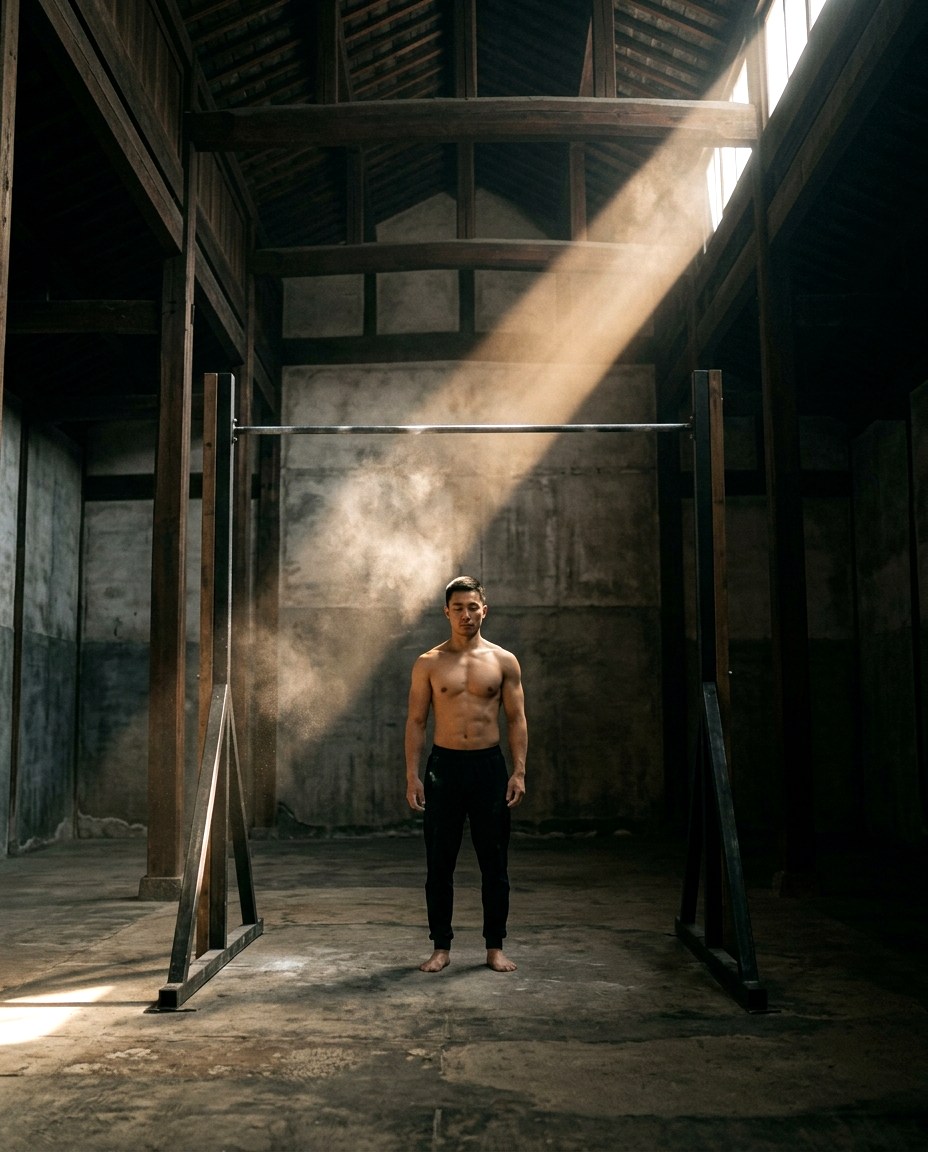
A samurai did not train the sword only to swing a sword. He trained to become someone who could stand still while everything around him moved. The bar works the same way. The skills are what people see. The mind is what you keep.
- Core Takeaway: Real progress in mindset comes from strict full-range reps, tendon patience, and logging every session in ink.
- The Science in Plain English: Muscles adapt in weeks, while tendons need structured 3-week build blocks followed by a Week 4 recovery deload.
- Put It Into Practice: Follow the interactive 28-Day Bar Blueprint below on Monday, Wednesday, Friday, and Saturday.
A thousand days to forge
In the Water Scroll of The Book of Five Rings, written around 1645, Miyamoto Musashi measured mastery in two numbers. A thousand days of training forge a swordsman. Ten thousand days refine him. A thousand days is nearly three years. Ten thousand is more than twenty-seven.
Anyone who has chased a planche knows the arithmetic is honest. The first thousand days build the tools: tendons that can take the load, shoulders that can hold the lean, the patience to return after weeks of no visible progress. The ten thousand are everything after: refinement, control, the ability to make the hardest thing look like nothing at all.
The kata and the rep
Japanese martial arts are built on kata: set forms repeated until they stop being techniques and become part of the body. A swordsman cut the same cut thousands of times, not because he did not know it, but because knowing it was not enough.
Calisthenics has its own kata. The hollow body. The scapular pull. The lean of a planche, the stack of a handstand, the turn of a muscle-up. You will repeat them for years. The repetition is not the boring part of the art. It is the art.
Shu, ha, ri
The martial arts describe learning in three stages. Shu: follow the form exactly, as you were taught. Ha: break from it, once you understand why it works. Ri: leave it behind, because the form now lives in you and you are free to create.
Every calisthenics athlete walks the same path. Shu is following the progressions, tuck before straddle, strict before kipping, because the people before you learned what happens when you skip. Ha is learning which rules bend for your body. Ri is freestyle in its truest sense: a combination nobody has done, because you understand the bar well enough to invent on it.
Calm under load
A swordsman’s training aimed at a state the Zen tradition calls mushin, usually translated as no-mind: acting fully, without hesitation and without the noise of fear or ego. Athletes call it being in the zone.
Hold a front lever for ten seconds and you will meet your own mind. At three seconds it tells you to stop. At five it tells you the hold is ugly. At eight it tells you there is no point. Learning to hear that voice and keep the line anyway is mental training no app can sell you. The bar is the teacher, and gravity never lets you cheat the lesson.
The bar never lies. Every second you hold is a second you earned.
What the mind gains
- Patience — progress measured in months and years, not sessions.
- Focus — a hold leaves no room for a wandering mind.
- Composure — breathing and staying tight while everything burns.
- Humility — the bar does not care how strong you were last month.
- Resolve — coming back after the failed attempt, again and again.
The sword was never the point
Musashi taught that someone who truly understands one way can see it in all things. A person who has really trained one art carries its lessons into everything else. The patience you build waiting on a planche is the patience you bring to your work. The calm you find at the end of a hold is the calm you bring to a hard conversation.
Skills come and go with age and injury. The mind you forged earning them stays.
Fudōshin and Zanshin: the two samurai states of a static hold
Beyond mushin (no-mind), classical Japanese swordsmanship (kenjutsu) and Zen brushwork cultivate two specific psychological states that every serious calisthenics athlete recognizes the moment they chalk up: fudōshin and zanshin.
Fudōshin translates literally as “immovable mind” or “unshakeable heart.” In the treatise Fudōchi Shinmyōroku (The Unfettered Mind), written by the Zen monk Takuan Sōhō for the swordmaster Yagyū Munenori in the seventeenth century, an immovable mind is not a rigid or frozen mind; it is a centre of gravity that refuses to be displaced by external shock or internal panic. When you kick up into a freestanding handstand in a windy park or step onto a competition platform for a third-attempt weighted dip, your heart rate spikes and adrenaline floods your bloodstream. Fudōshin is the trained ability to feel that surge of arousal without letting it alter your breathing, your grip pressure or your scapular depression.
Zanshin means “remaining mind”—total, unbroken awareness that continues through the completion of an action and after it ends. In archery (kyūdō) and swordsmanship, a strike that lands brilliantly is still failed if the practitioner drops their guard or celebrates prematurely. On the bar, zanshin is how you dismount. Amateur athletes collapse out of a front lever or drop from the top of a muscle-up the instant the rep is “done.” Masters lower out of the hold with control, land softly on the balls of their feet, and step away from the bar in silence. The set is not over until your feet are on the ground and your breathing is yours again.
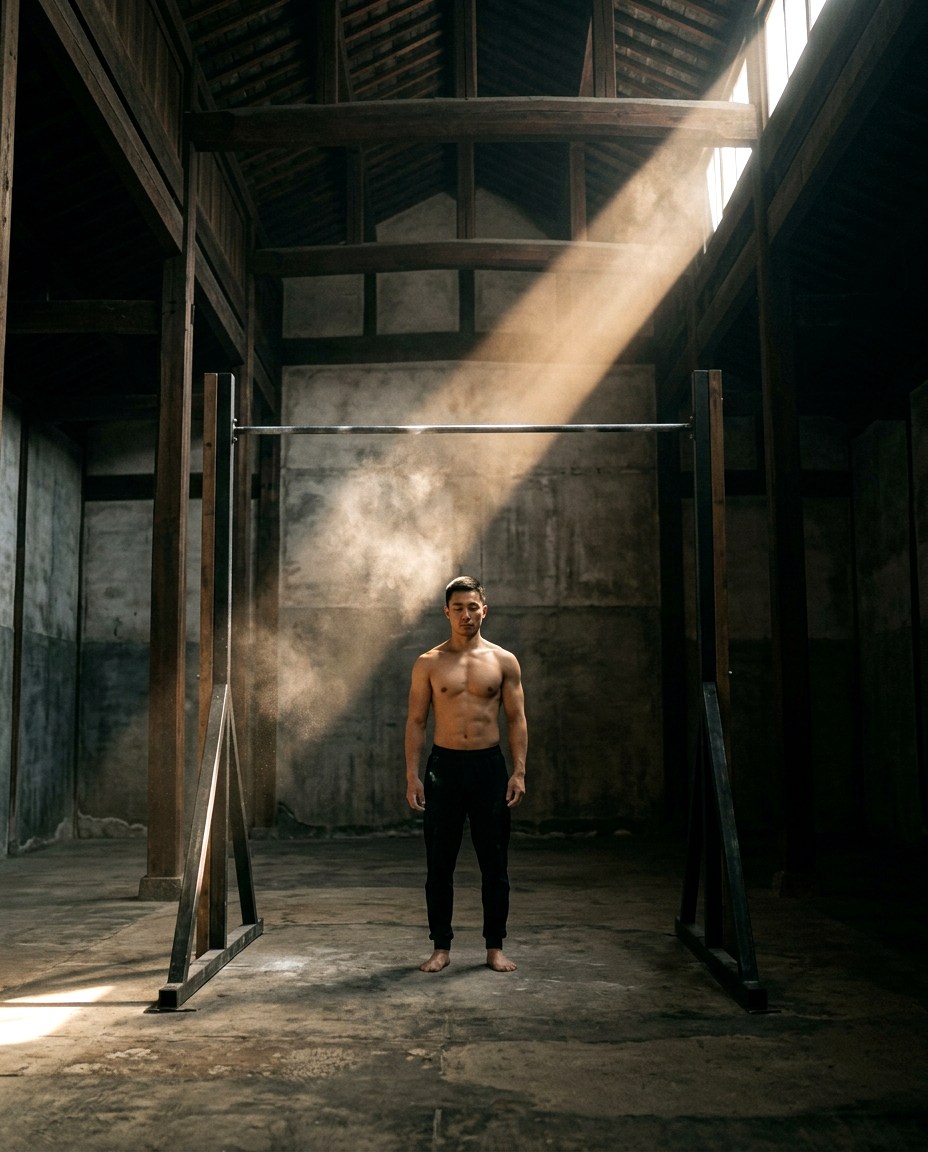
Three years of consistent training to build the structural hardware: callused palms, dense elbow tendons, strict pull-ups and dips, and a 60-second hollow body.
Twenty-seven years of refinement: removing every wasted millimetre of movement until a straddle press or a slow muscle-up looks weightless.
Staying calm at second seven of a ten-second isometric hold when local ischemia and motor-unit tremor tell you to drop.
Owning the eccentric lowering phase and the dismount with the same precision you gave the entry.
The Park vs. Platform Reality Check: What Separates Real Progress From Ego
Ten-second social media clips only show the one lucky attempt filmed on fresh legs. Real calisthenics happens on a cold morning when nobody is watching, or on a competition platform when three referees are staring at your elbow lockout. Here is how the Anti Gravity Club standard compares to common park shortcuts in The Way of the Bar: Training the Mind Like a Samurai Trains the Sword:
| Training Habit | The Ego / Highlight-Reel Mistake | The Anti Gravity Club Standard | Result After 12 Months |
|---|---|---|---|
| Range of Motion | Stopping 2 inches short of a dead hang on pull-ups and cutting dips shallow | Dead stop at the bottom to chin/chest over bar; shoulder below elbow on every dip (ISF Rules v5.2) | Thicker muscle belly growth, bulletproof joints at full range, and competition-legal reps |
| Static Hold Quality | Holding a shaky 2-second progression with bent elbows and piked hips | Stacking 5–6 crisp sets of 6–8 seconds with locked triceps and squeezed glutes | Pain-free elbows and steady progression to straddle and full holds |
| Tracking Progress | Doing random circuits until tired with no record of reps, weights, or rest | Writing down Bodyweight + Belt Weight, sets, reps, and 3-minute rests in a logbook | Predictable strength gains every 4-week block with zero guesswork |
| Joint Recovery | Ignoring wrist or elbow tightness until an injury forces months off | 8-minute warm-up before every session and a lighter Week 4 deload every month | 52 unbroken weeks of training—the real secret behind elite calisthenics athletes |
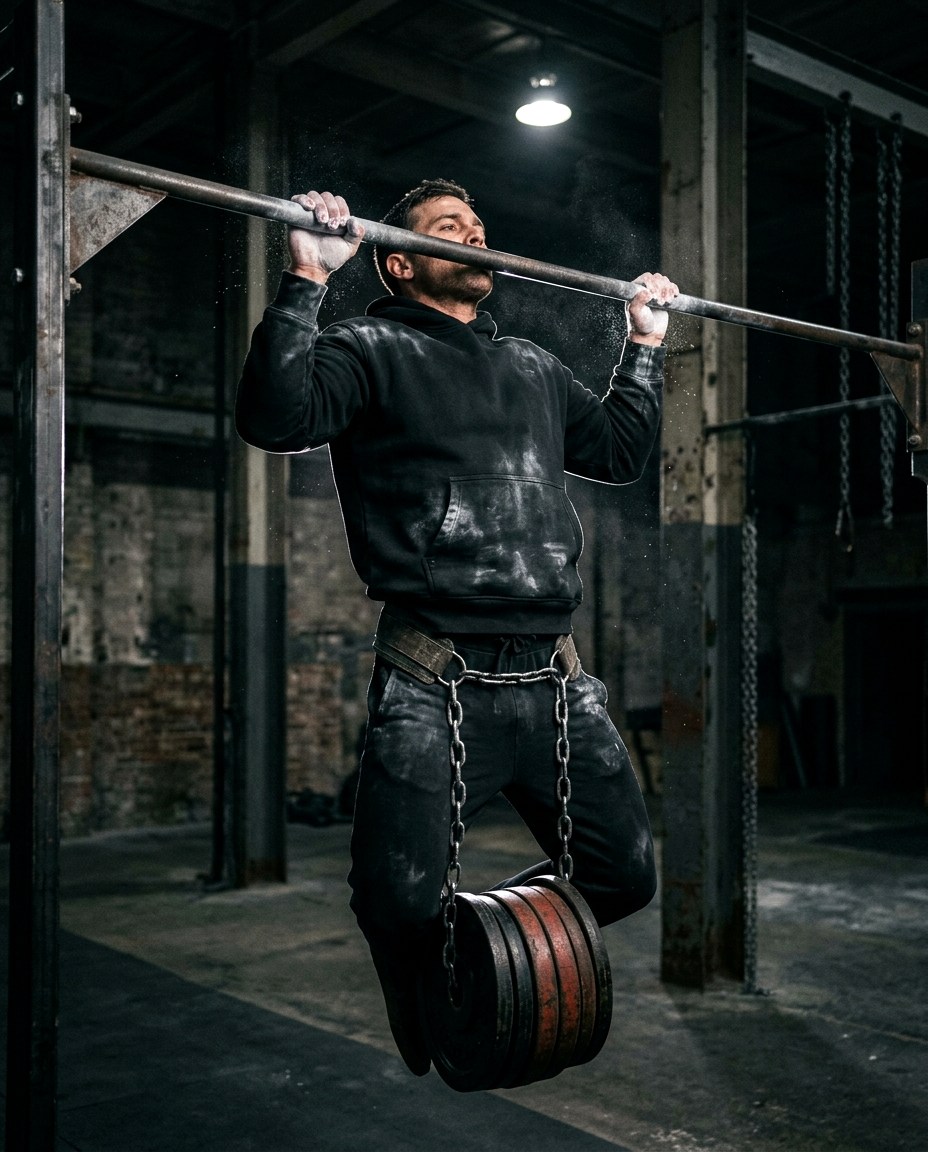
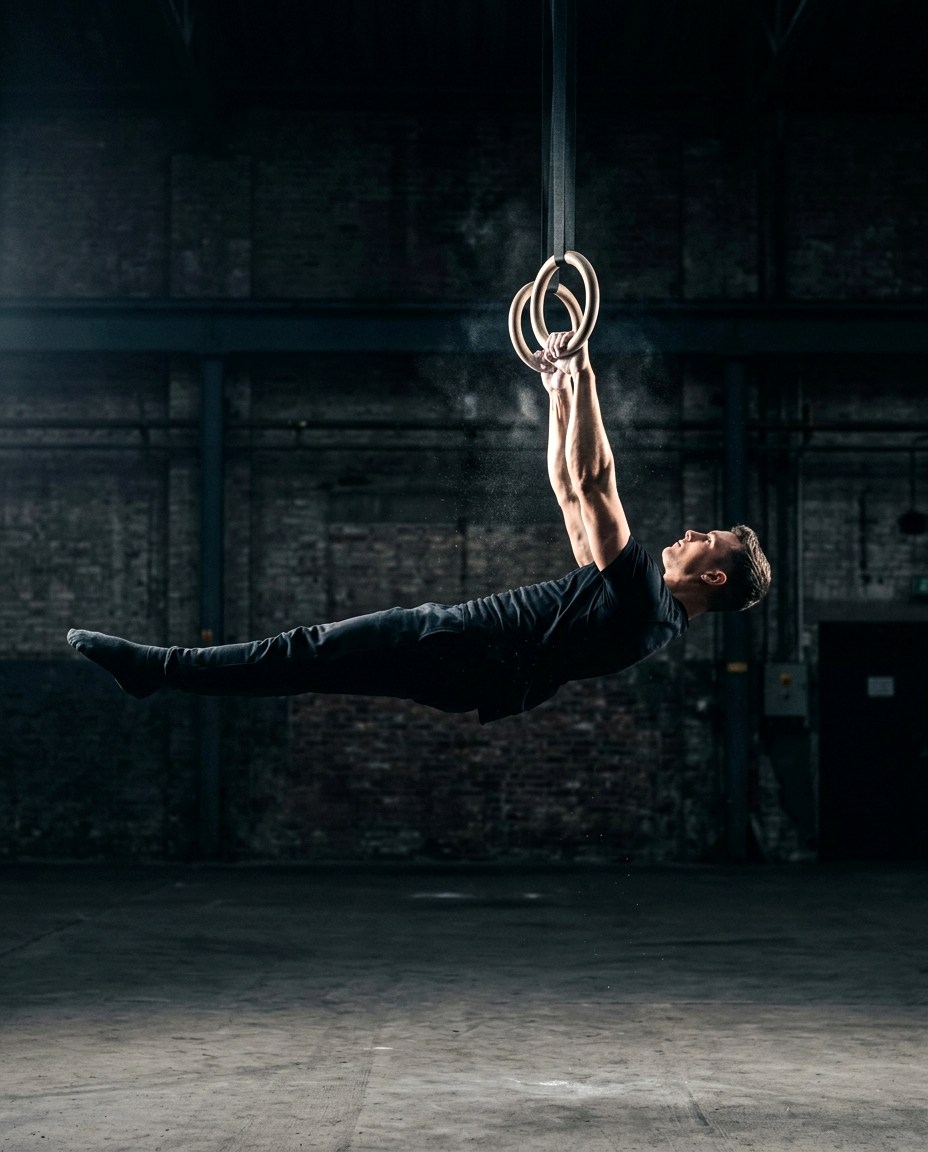
From Cold Park Warm-Ups to Platform Top Sets
Built for athletes who move their own bodyweight: pair our Fleece Zip-Up Boxy Hoodie ($61.94) and Unisex Oversized OG Crewneck ($39.94) with the raw-edge Anti Grav Cut-Off ($39.99).
The 28-Day Bar Blueprint: Step-by-Step 4-Week Training Plan
Reading about biomechanics won’t build a single rep unless you bring a clear plan to the bar. Below is your complete, easy-to-follow 4-Week Training Blueprint for The Way of the Bar: Training the Mind Like a Samurai Trains the Sword. First, click through Weeks 1 to 4 to see how your effort and reps change each week; then follow the 4 Weekly Workout Cards (Monday, Wednesday, Friday, Saturday) below.
How to Progress Across All 4 Weeks
Pick a progression or weight where every single rep looks textbook. Lower yourself for a full 3-second count and pause 1 second at the bottom.
Film your first and last set from the side at waist height so you have a Day 1 video to compare against Day 28.
Smooth & Controlled: Finish every set feeling like you could have done 3 more clean reps.
Keep the exact same exercise variation or weight as Week 1. Do not rush to a harder variation yet—earn more volume with identical form.
Rest a full 3 minutes between main sets so your last set is just as crisp as your first.
Solid Work: Finish each set with 2 clean reps left in the tank. Zero form breakdown.
Now that your joints and nervous system are grooved, increase the challenge slightly on your first 2 top sets while keeping strict lockout.
Prioritize 8 hours of sleep and high protein (1.6–2.0 g/kg bodyweight) to recover from peak week.
High Tension: Stop 1 rep short of failure. Never grind through elbow or shoulder pain.
Cut your sets by 50% on Monday and Wednesday so fatigue clears and your tendons supercompensate. Take Thursday and Friday off.
On Saturday (Day 28), warm up for 15 minutes and film your new Personal Best from the exact same angle as Day 1.
Fresh & Explosive: Easy sessions Mon/Wed so you feel weightless on Saturday’s test.
Exact Day-by-Day Session Cards
Upper-Body Strength & Skill
Wrist circles, 30s passive hang & 10 active scapular pulls
Handstand balance against wall/freestanding or L-Sit holds
Strict Pull-Ups paired with Parallel-Bar Dips (Rest 90s between moves)
Hollow Body Hold (lower back pressed flat) + Arch Hold
Legs, Core & Mobility
Deep resting squat hold (2 min) + Cossack lunges
Assisted Pistol Squats, Shrimp Squats, or Deep Split Squats
Nordic Hamstring Lowerings or Single-Leg Hip Thrusts
Pancake straddle fold + Pike compression leg lifts
Horizontal Control & Volume
Band shoulder dislocates, wrist rocks & 10 slow push-ups
Tuck Front Lever or Planche Lean with locked elbows
Bodyweight Ring/Bar Rows paired with Diamond or Pseudo-Planche Push-Ups
Two-Arm Dead Hang + 15 Band Face Pulls
Flow, Density & Prehab
5 Pull-Ups + 8 Dips + 10 Squats + 15s L-Sit (Rest 90s per round)
Crow pose, handstand balance, or bar flow transitions
Light wrist curls, reverse wrist curls & finger extensions
Relaxed dead hang and deep nasal breathing
Frequently Asked Questions
How many days per week should I run this The Way of the Bar: Training the Mind Like a Samurai Trains the Sword blueprint?
Four sessions per week (Monday, Wednesday, Friday, Saturday) gives you the ideal balance of practice frequency and tendon recovery. If your schedule is tight, perform Monday, Wednesday, and Friday (3 days/week) and keep Tuesday, Thursday, and weekends as active rest.
What if an exercise in the workout card is too hard or too easy for my current level?
Adjust the leverage, not the form. If you cannot hit the minimum reps with locked elbows and a smooth 3-second lowering phase, step back one variation (for example, move from Advanced Tuck to Tuck, or reduce dip-belt weight by 5 kg). If you hit the top of the rep range easily on all sets in Week 3, advance to the next variation in your next 4-week block.
Why do we cut sets in half during Week 4 instead of pushing harder?
Muscles recover in 48 to 72 hours, but tendons and elbow/shoulder connective tissues need every fourth week at lighter volume to finish laying down new collagen fibres (Kjaer et al., 2009; Bohm et al., 2015). Week 4 is where your body locks in the strength you built in Weeks 1–3.
What gear do I actually need in my bag for this 4-week block?
Keep it simple: liquid or block chalk for grip security, a notebook or phone timer to track your sets and 3-minute rests, wooden rings or parallettes if floor work bothers your wrists, and an unrestricted top like the Anti Grav Cut-off ($39.99) paired with a warm layer like the Fleece Zip-Up Boxy Hoodie ($61.94).
Forge the body.
Refine the mind.
Ten thousand days.
Source: Miyamoto Musashi, The Book of Five Rings (Go Rin no Sho), c. 1645, the Water Scroll.
Train in the club’s colours. Anti Gravity Club makes training apparel for people who move their own bodyweight: heavyweight boxy hoodies, oversized crewnecks, raw-edge cut-offs and straight-leg sweats built for the bar and the street. Shop the club

Leave a Reply