

Nobody watching a muscle-up sees the discipline behind it. They see one clean rep. They do not see the hundreds of mornings it took, most of them cold, tired and unremarkable. Calisthenics is a skill sport, but the first skill it teaches is showing up.
- Core Takeaway: Real progress in discipline comes from strict full-range reps, tendon patience, and logging every session in ink.
- The Science in Plain English: Muscles adapt in weeks, while tendons need structured 3-week build blocks followed by a Week 4 recovery deload.
- Put It Into Practice: Follow the interactive 28-Day Bar Blueprint below on Monday, Wednesday, Friday, and Saturday.
Motivation gets you to the bar once
Motivation is a feeling, and feelings are unreliable. It is strong after a great video and gone after a bad day at work. If your training depends on wanting to train, it stops the first week you do not.
Discipline is what remains when the feeling has gone. It is deciding once and then not deciding again: Monday, Wednesday, Friday, at the bar, whatever the weather, whatever the mood. The decision is already made. You only have to carry it out.
The bar keeps an honest record
Most of life lets you hide a little. Calisthenics does not. You held the lever or you did not. Your chin cleared the bar or it did not. Your bodyweight is the same load every session, so every week you can see exactly what your consistency has bought you.
That honesty is uncomfortable at first and freeing later. There is nobody to blame and no shortcut to buy. Progress is a direct read-out of the work.
What the sport demands
Consistency over intensity
One brutal session a week loses to three good ones, every time. Skills are built by frequency: the nervous system learns what it practises often. The athlete who trains steadily for a year beats the one who trains furiously for a month.
Patience with slow things
Muscle adapts in weeks. Tendons and ligaments take months. Skills take years. Discipline in calisthenics means respecting the slowest tissue in your body, and not rushing a progression because your ego is ready before your elbows are.
Doing the unglamorous work
Wrist preparation. Scapular work. Mobility. Hollow body holds. Nobody films them, and everybody who skips them pays later. Discipline is treating the boring work as seriously as the impressive work.
Rest as part of the plan
Discipline is also knowing when to stop: sleeping enough, eating enough, taking the rest day when the plan says rest. Training through every warning sign is not discipline. It is impatience dressed up as toughness.
- Decide once — fixed days and times beat a daily debate with yourself.
- Track everything — reps, holds and how they felt. The log keeps you honest.
- Keep a minimum — on bad days, do the warm-up and one good set. Never break the chain.
- Basics first — pull, push, legs and core, every week, before the skills.
- Rest on purpose — recovery is training you do away from the bar.
It does not stay at the bar
Something happens after a year of keeping promises to yourself on a pull-up bar: you start keeping them everywhere else. The person who trains at six in the morning in the cold finds it easier to do the hard thing at work, to have the difficult conversation, to start the project they have been putting off.
Discipline is not a trait you are born with. It is a muscle, and the bar trains it as surely as it trains your back. That is the real reason we train. The muscle-up is the proof. The discipline is the prize.
The neuroscience of showing up: habit loops and the anterior midcingulate cortex
When we say that discipline is trained like a muscle, modern neuroscience backs the metaphor with physical anatomy. Behavioral research on habit formation—such as Phillippa Lally and colleagues’ landmark study in the European Journal of Social Psychology—demonstrates that repeating a behavior in a consistent context progressively shifts neural control from the prefrontal cortex (which requires conscious, exhausting willpower) to the basal ganglia (which executes routines automatically). On average, automaticity took 66 days to plateau, and missing a single day did not destroy the habit—provided the person returned immediately the next time.
Even more striking is contemporary neuroimaging of the anterior midcingulate cortex (aMCC), a hub in the brain that integrates effort cost, tenacious persistence and cognitive control. Neuroscientists have observed that the aMCC activates and structurally adapts specifically when a human being chooses to do something difficult that they do not want to do—and shrinks with passivity and comfort. A workout you are excited to do is fun, and it builds your lats; a cold, rainy Tuesday session that you dread and complete anyway builds your anterior midcingulate cortex.

The four-part architecture of unbreakable training consistency
Lay out your hoodie, cut-off, wrist wraps, chalk and logbook before you sleep. Every decision you eliminate at 6:00 AM is one less opportunity to negotiate with your alarm.
Replace vague goals (‘I’ll train four times this week’) with locked coordinates: ‘Monday, Wednesday, Friday and Saturday at 06:30 on the park bars.’
Establish a floor you never drop below. On days when life, illness or exhaustion hits hard, show up, complete your 10-minute wrist and shoulder prep and one strict set, and go home. Protect the identity of someone who never misses.
Judge your month by sessions completed (e.g., 16/16) rather than whether your planche hold went up by two seconds this week. Control the input; let physiology handle the output.
The Park vs. Platform Reality Check: What Separates Real Progress From Ego
Ten-second social media clips only show the one lucky attempt filmed on fresh legs. Real calisthenics happens on a cold morning when nobody is watching, or on a competition platform when three referees are staring at your elbow lockout. Here is how the Anti Gravity Club standard compares to common park shortcuts in Discipline Is the Real Skill:
| Training Habit | The Ego / Highlight-Reel Mistake | The Anti Gravity Club Standard | Result After 12 Months |
|---|---|---|---|
| Range of Motion | Stopping 2 inches short of a dead hang on pull-ups and cutting dips shallow | Dead stop at the bottom to chin/chest over bar; shoulder below elbow on every dip (ISF Rules v5.2) | Thicker muscle belly growth, bulletproof joints at full range, and competition-legal reps |
| Static Hold Quality | Holding a shaky 2-second progression with bent elbows and piked hips | Stacking 5–6 crisp sets of 6–8 seconds with locked triceps and squeezed glutes | Pain-free elbows and steady progression to straddle and full holds |
| Tracking Progress | Doing random circuits until tired with no record of reps, weights, or rest | Writing down Bodyweight + Belt Weight, sets, reps, and 3-minute rests in a logbook | Predictable strength gains every 4-week block with zero guesswork |
| Joint Recovery | Ignoring wrist or elbow tightness until an injury forces months off | 8-minute warm-up before every session and a lighter Week 4 deload every month | 52 unbroken weeks of training—the real secret behind elite calisthenics athletes |

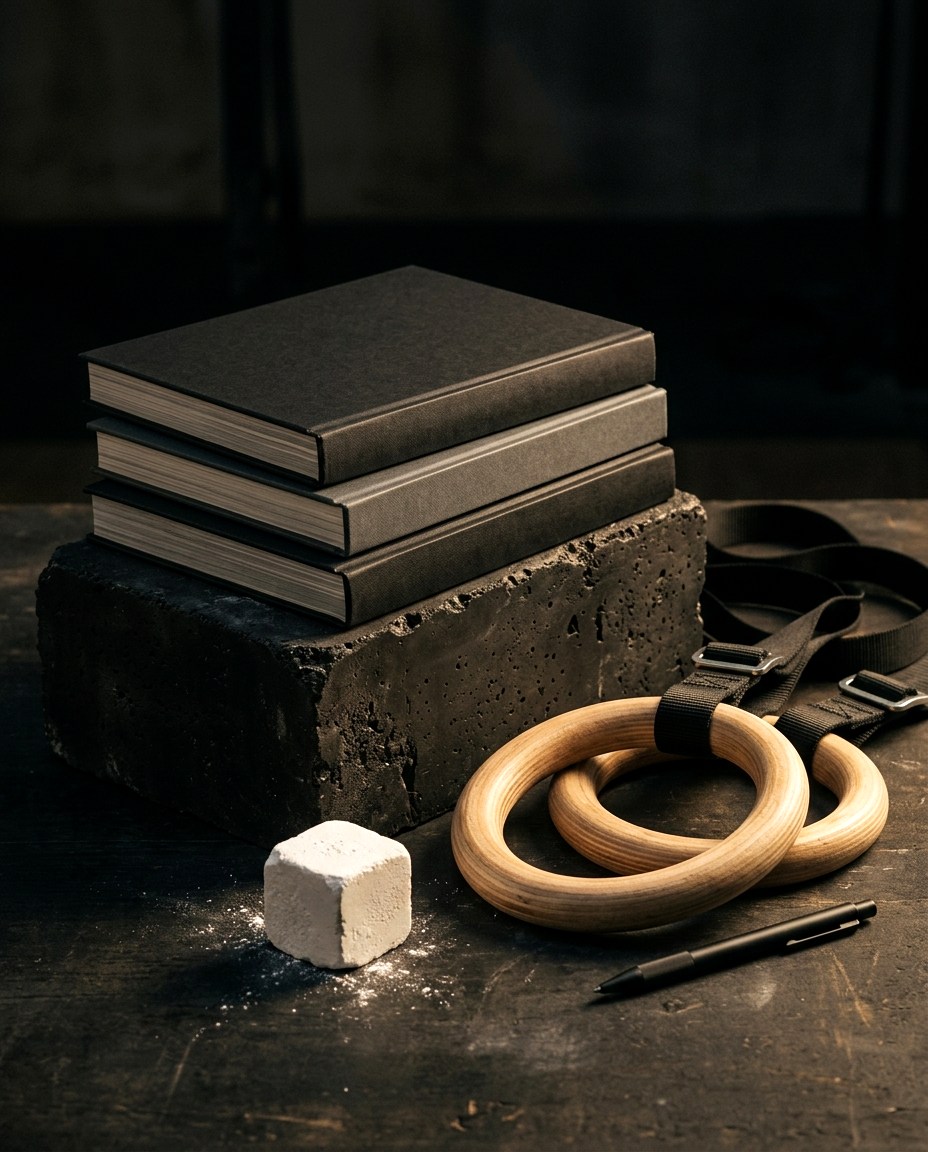
From Cold Park Warm-Ups to Platform Top Sets
Built for athletes who move their own bodyweight: pair our Fleece Zip-Up Boxy Hoodie ($61.94) and Unisex Oversized OG Crewneck ($39.94) with the raw-edge Anti Grav Cut-Off ($39.99).
The 28-Day Bar Blueprint: Step-by-Step 4-Week Training Plan
Reading about biomechanics won’t build a single rep unless you bring a clear plan to the bar. Below is your complete, easy-to-follow 4-Week Training Blueprint for Discipline Is the Real Skill. First, click through Weeks 1 to 4 to see how your effort and reps change each week; then follow the 4 Weekly Workout Cards (Monday, Wednesday, Friday, Saturday) below.
How to Progress Across All 4 Weeks
Pick a progression or weight where every single rep looks textbook. Lower yourself for a full 3-second count and pause 1 second at the bottom.
Film your first and last set from the side at waist height so you have a Day 1 video to compare against Day 28.
Smooth & Controlled: Finish every set feeling like you could have done 3 more clean reps.
Keep the exact same exercise variation or weight as Week 1. Do not rush to a harder variation yet—earn more volume with identical form.
Rest a full 3 minutes between main sets so your last set is just as crisp as your first.
Solid Work: Finish each set with 2 clean reps left in the tank. Zero form breakdown.
Now that your joints and nervous system are grooved, increase the challenge slightly on your first 2 top sets while keeping strict lockout.
Prioritize 8 hours of sleep and high protein (1.6–2.0 g/kg bodyweight) to recover from peak week.
High Tension: Stop 1 rep short of failure. Never grind through elbow or shoulder pain.
Cut your sets by 50% on Monday and Wednesday so fatigue clears and your tendons supercompensate. Take Thursday and Friday off.
On Saturday (Day 28), warm up for 15 minutes and film your new Personal Best from the exact same angle as Day 1.
Fresh & Explosive: Easy sessions Mon/Wed so you feel weightless on Saturday’s test.
Exact Day-by-Day Session Cards
Upper-Body Strength & Skill
Wrist circles, 30s passive hang & 10 active scapular pulls
Handstand balance against wall/freestanding or L-Sit holds
Strict Pull-Ups paired with Parallel-Bar Dips (Rest 90s between moves)
Hollow Body Hold (lower back pressed flat) + Arch Hold
Legs, Core & Mobility
Deep resting squat hold (2 min) + Cossack lunges
Assisted Pistol Squats, Shrimp Squats, or Deep Split Squats
Nordic Hamstring Lowerings or Single-Leg Hip Thrusts
Pancake straddle fold + Pike compression leg lifts
Horizontal Control & Volume
Band shoulder dislocates, wrist rocks & 10 slow push-ups
Tuck Front Lever or Planche Lean with locked elbows
Bodyweight Ring/Bar Rows paired with Diamond or Pseudo-Planche Push-Ups
Two-Arm Dead Hang + 15 Band Face Pulls
Flow, Density & Prehab
5 Pull-Ups + 8 Dips + 10 Squats + 15s L-Sit (Rest 90s per round)
Crow pose, handstand balance, or bar flow transitions
Light wrist curls, reverse wrist curls & finger extensions
Relaxed dead hang and deep nasal breathing
Frequently Asked Questions
How many days per week should I run this Discipline Is the Real Skill blueprint?
Four sessions per week (Monday, Wednesday, Friday, Saturday) gives you the ideal balance of practice frequency and tendon recovery. If your schedule is tight, perform Monday, Wednesday, and Friday (3 days/week) and keep Tuesday, Thursday, and weekends as active rest.
What if an exercise in the workout card is too hard or too easy for my current level?
Adjust the leverage, not the form. If you cannot hit the minimum reps with locked elbows and a smooth 3-second lowering phase, step back one variation (for example, move from Advanced Tuck to Tuck, or reduce dip-belt weight by 5 kg). If you hit the top of the rep range easily on all sets in Week 3, advance to the next variation in your next 4-week block.
Why do we cut sets in half during Week 4 instead of pushing harder?
Muscles recover in 48 to 72 hours, but tendons and elbow/shoulder connective tissues need every fourth week at lighter volume to finish laying down new collagen fibres (Kjaer et al., 2009; Bohm et al., 2015). Week 4 is where your body locks in the strength you built in Weeks 1–3.
What gear do I actually need in my bag for this 4-week block?
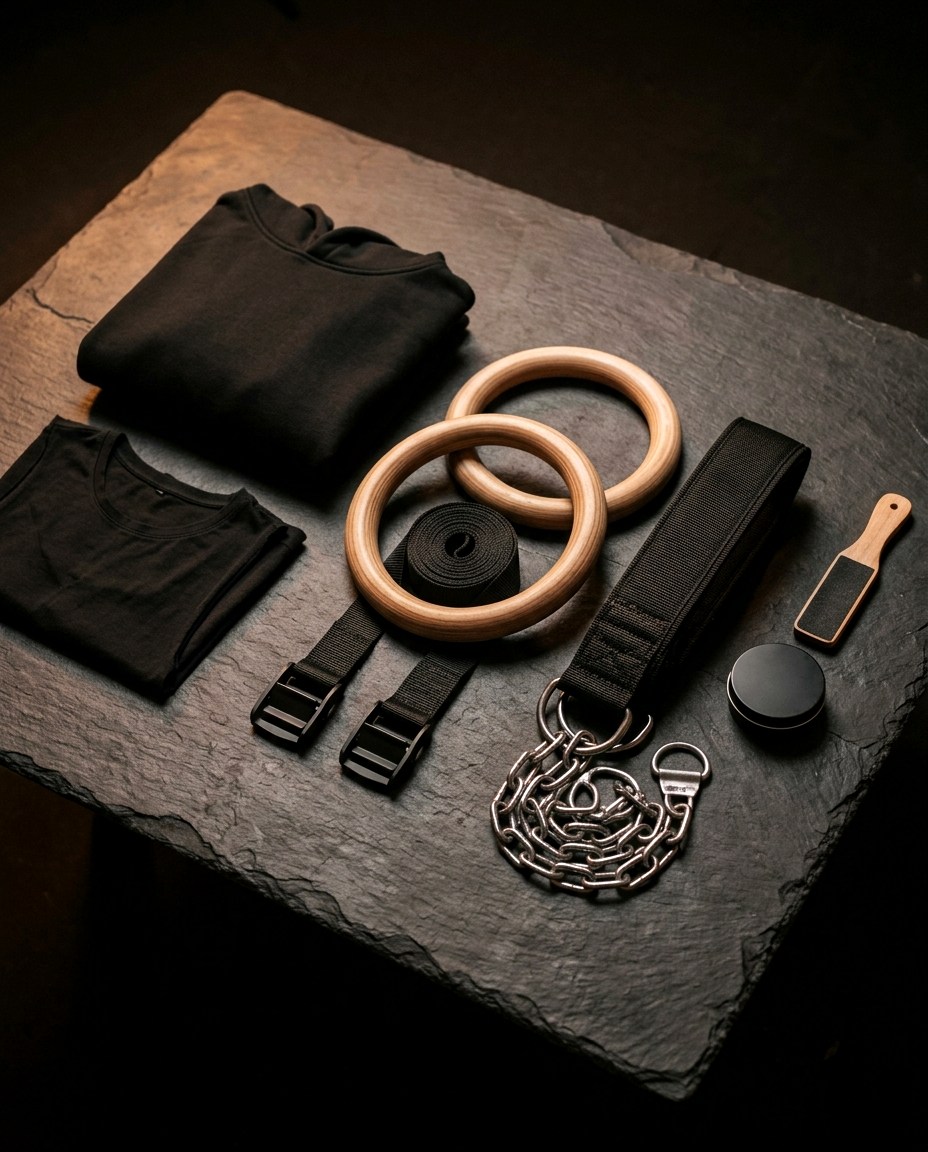
Keep it simple: liquid or block chalk for grip security, a notebook or phone timer to track your sets and 3-minute rests, wooden rings or parallettes if floor work bothers your wrists, and an unrestricted top like the Anti Grav Cut-off ($39.99) paired with a warm layer like the Fleece Zip-Up Boxy Hoodie ($61.94).
Right Here. Right Now.
Again tomorrow.
Train in the club’s colours. Anti Gravity Club makes training apparel for people who move their own bodyweight: heavyweight boxy hoodies, oversized crewnecks, raw-edge cut-offs and straight-leg sweats built for the bar and the street. Shop the club



Leave a Reply