
Handstands, planche work and heavy dips put your wrists through a lot. Wrist wraps add support and warmth on long or heavy sessions. Used well, they are a tool; used for everything, they become a crutch. Here is how to choose them.
- What Matters Most: Buy durable, competition-grade essentials that survive outdoor weather and heavy chalk instead of gimmicky gadgets.
- How to Choose: Match your lists setup to your current strength tier (Foundation, Intermediate, or Streetlifter).
- Action Plan Included: Scroll to the interactive 28-Day Bar Blueprint below for your exact Monday–Saturday schedule.
1. Elastic cotton wraps
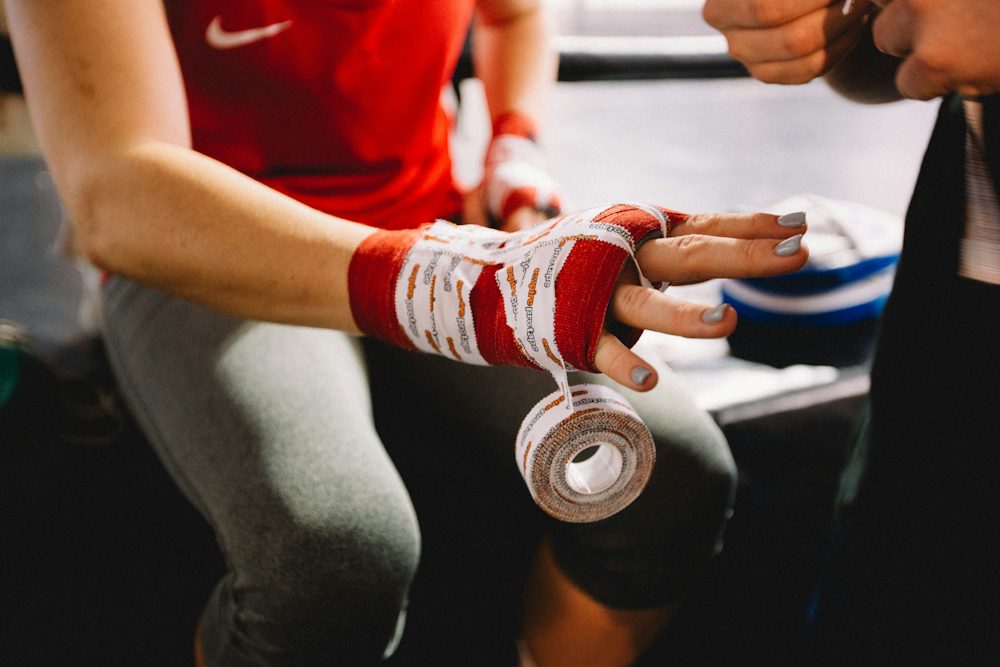
Soft, stretchy wraps with a thumb loop and a hook-and-loop closure. The most common choice for calisthenics: supportive without locking the wrist, so you still feel the floor.
2. Stiff wraps
Thicker, firmer wraps made for heavy pressing in powerlifting. Useful for heavy weighted dips, but too stiff for most balance work.
3. Sweatbands and sleeves
Light compression and warmth with almost no restriction. Good for long handstand sessions on cold days.
What to check
- Length — longer wraps give more turns and more support; shorter ones are lighter.
- Stiffness — softer for balance, firmer for heavy pressing.
- Closure — a wide hook-and-loop strip that holds.
- Thumb loop — helps you wrap tight, but take it off your thumb before you lift.
Use them well
- Warm the wrists up before every session, wraps or not.
- Train most of your volume without them, so the wrists keep getting stronger.
- Save them for heavy sets, long sessions and sore days.
- Wrap snugly, not so tight that your hand tingles.
Twist-style calisthenics wraps vs. powerlifting velcro wraps: choosing the right support
Not all wrist wraps are built for the same sport. Walk into a powerlifting meet and lifters wear thick, cast-like 80 cm elastic-and-velcro wraps designed to immobilize the wrist in neutral alignment under a 250 kg bench press. Put that same wrap on for a freestanding handstand or a floor planche and you cannot extend your wrist to 85 degrees or feel your fingertips pressing into the floor.
Thin, non-elastic or low-stretch woven cotton/canvas wraps (75–90 cm long) secured with a cord that twists to tighten or loosens in one second between sets. They cradle the distal radioulnar joint without blocking finger proprioception.
Under ISF Rules v5.2 Section 5, competition wrist wraps may be up to 1 metre long and 8 cm wide. Medium-stiffness cotton-elastic velcro wraps give ideal support for heavy weighted dips and muscle-ups.
A wrap worn two inches down your forearm does nothing. Wrap directly across the wrist crease—covering 2 cm of the base of the hand and 4 cm of the distal radius and ulna—to reinforce the dorsal capsule.
Do your warm-ups, wrist prep, and first 60–70% of your weekly handstand/pushing volume bare-wristed so your intrinsic wrist stabilizers and carpal ligaments continue to adapt.
Stage-by-Stage Comparison: What You Need at Each Level
What works in your first three months at a local park is different from what you need when you are hanging two 20 kg plates from a dip belt or working toward a full front lever. Cheap chrome bars get slick in summer humidity, thin bands lose tension after a season in a backpack, and tight sleeves restrict your shoulders as soon as you reach overhead. Use the comparison table below to match Wrist Wraps for Handstands and Planche: What to Look For to your current level:
| Athlete Stage | Main Focus at the Bar | What to Look For | Mistake to Avoid | Recommended AGC Kit |
|---|---|---|---|---|
| Beginner (Months 0–6) 0–8 Pull-Ups · Learning Form | Building grip endurance, active shoulders, and 3-second lowering control (3–4 days/week) | 28–32 mm grip bar, 28 mm birch wooden rings, liquid chalk, and a training logbook | Buying workout gloves or gimmicks instead of building real calluses and shoulder control | Anti Grav Cut-off ($39.99) + Sorona Classic Tee ($25.94) |
| Intermediate (Months 6–24) 10–15 Pull-Ups · First Muscle-Up & Tuck Holds | Adding small weights (+5–25 kg), bridging leverage gaps, and 15 min handstands | Contoured dip belt, 40 mm wooden parallettes, and cloth twist-lock wrist wraps | Jumping to full levers/planche before your elbow tendons have adapted | Anti Grav Cut-off ($39.99) + Oversized OG Crewneck ($39.94) |
| Advanced & Streetlifter (Years 2+) +35–75 kg Pull-Up · Full Statics & Meets | 4-week wave blocks, strict competition depth, and year-round joint health | ISF-legal non-elastic dip belt strap, 0.5 kg micro-plates, and side-angle phone tripod | Maxing out to sloppy failure every workout instead of stacking crisp sets | Fleece Zip-Up Boxy Hoodie ($61.94) + Anti Grav Cut-off |

From Cold Park Warm-Ups to Platform Top Sets
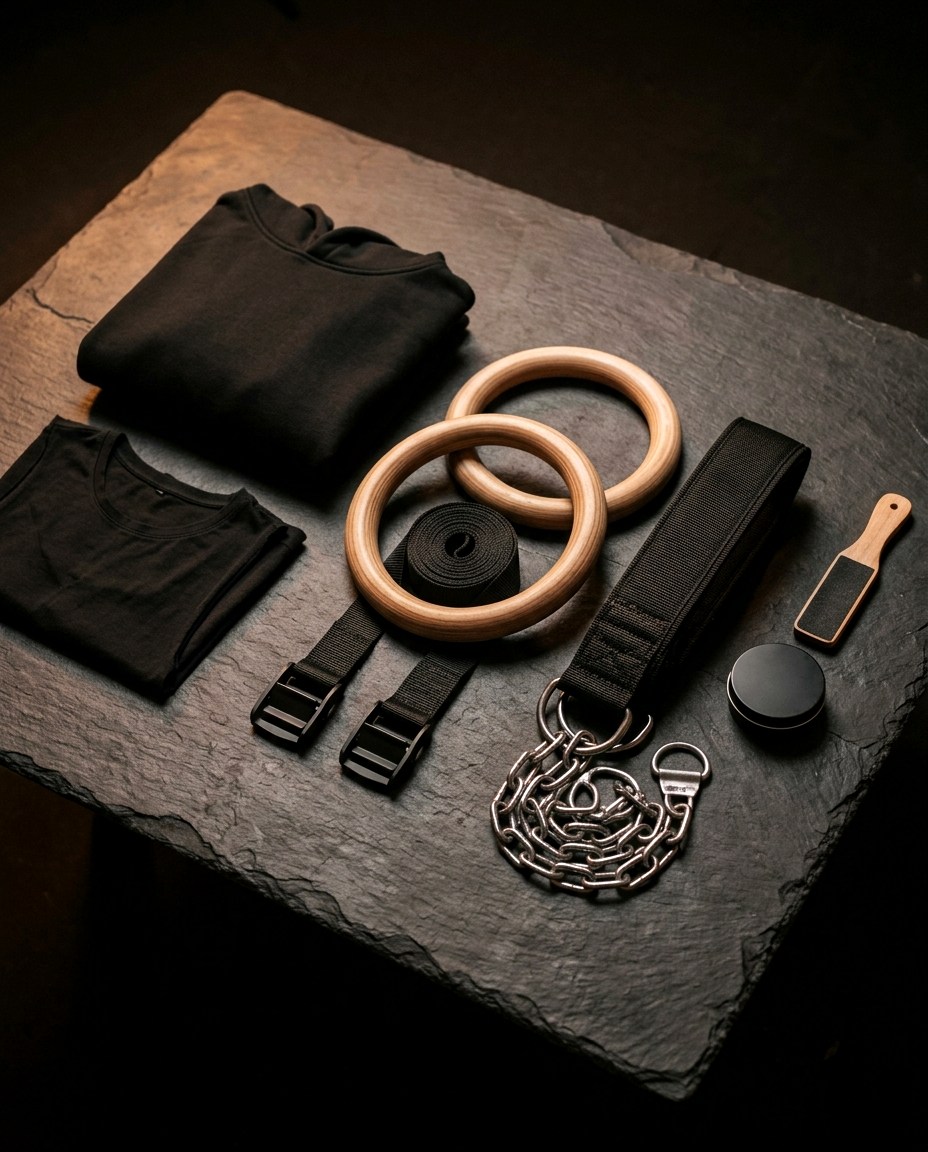
Built for athletes who move their own bodyweight: pair our Fleece Zip-Up Boxy Hoodie ($61.94) and Unisex Oversized OG Crewneck ($39.94) with the raw-edge Anti Grav Cut-Off ($39.99).
The 28-Day Bar Blueprint: Step-by-Step 4-Week Training Plan
Reading about biomechanics won’t build a single rep unless you bring a clear plan to the bar. Below is your complete, easy-to-follow 4-Week Training Blueprint for Wrist Wraps for Handstands and Planche: What to Look For. First, click through Weeks 1 to 4 to see how your effort and reps change each week; then follow the 4 Weekly Workout Cards (Monday, Wednesday, Friday, Saturday) below.
How to Progress Across All 4 Weeks
Pick a progression or weight where every single rep looks textbook. Lower yourself for a full 3-second count and pause 1 second at the bottom.
Film your first and last set from the side at waist height so you have a Day 1 video to compare against Day 28.
Smooth & Controlled: Finish every set feeling like you could have done 3 more clean reps.
Keep the exact same exercise variation or weight as Week 1. Do not rush to a harder variation yet—earn more volume with identical form.
Rest a full 3 minutes between main sets so your last set is just as crisp as your first.
Solid Work: Finish each set with 2 clean reps left in the tank. Zero form breakdown.
Now that your joints and nervous system are grooved, increase the challenge slightly on your first 2 top sets while keeping strict lockout.
Prioritize 8 hours of sleep and high protein (1.6–2.0 g/kg bodyweight) to recover from peak week.
High Tension: Stop 1 rep short of failure. Never grind through elbow or shoulder pain.
Cut your sets by 50% on Monday and Wednesday so fatigue clears and your tendons supercompensate. Take Thursday and Friday off.
On Saturday (Day 28), warm up for 15 minutes and film your new Personal Best from the exact same angle as Day 1.
Fresh & Explosive: Easy sessions Mon/Wed so you feel weightless on Saturday’s test.
Exact Day-by-Day Session Cards
Primary Skill & Heavy Push
Wrist rocks, knuckle push-ups & 2×10 scapular push-ups
Planche Lean, Tuck Planche, or Handstand Hold (Rest 2.5 min)
Parallel-Bar Dips or Pike / Handstand Push-Ups (3 sec lower)
Protraction Push-Ups + 30 sec Hollow Body Hold
Slow Tempo & Full Range
Band shoulder dislocates, elbow circles & wrist stretches
Pseudo-Planche Push-Ups or Deep Dips (4 sec slow lower, 1 sec pause)
Chest-to-Bar Pull-Ups or Bodyweight Rows (keeps shoulders healthy)
Parallel-Bar Knee/Leg Raises + Light Dumbbell/Band Wrist Curls
Explosive Speed & Volume
2×20s handstand wall holds + 2×8 fast push-ups
Film from the side: lock elbows 100% before lifting feet
Every minute on the minute: 4 to 6 crisp Dips or Push-Ups
Bodyweight Triceps Extensions + Band Face Pulls
Balance Play, Legs & Mobility
Handstand kick-ups or crow/frog balance (low fatigue, high focus)
Bulgarian Split Squats or Assisted Pistol Squats + Calf Raises
Butcher’s Block stretch + Thoracic bridge / wall slides
Relaxed two-arm dead hang to open the shoulder joints
Frequently Asked Questions
How many days per week should I run this Wrist Wraps for Handstands and Planche: What to Look For blueprint?
Four sessions per week (Monday, Wednesday, Friday, Saturday) gives you the ideal balance of practice frequency and tendon recovery. If your schedule is tight, perform Monday, Wednesday, and Friday (3 days/week) and keep Tuesday, Thursday, and weekends as active rest.
What if an exercise in the workout card is too hard or too easy for my current level?
Adjust the leverage, not the form. If you cannot hit the minimum reps with locked elbows and a smooth 3-second lowering phase, step back one variation (for example, move from Advanced Tuck to Tuck, or reduce dip-belt weight by 5 kg). If you hit the top of the rep range easily on all sets in Week 3, advance to the next variation in your next 4-week block.
Why do we cut sets in half during Week 4 instead of pushing harder?
Muscles recover in 48 to 72 hours, but tendons and elbow/shoulder connective tissues need every fourth week at lighter volume to finish laying down new collagen fibres (Kjaer et al., 2009; Bohm et al., 2015). Week 4 is where your body locks in the strength you built in Weeks 1–3.
What gear do I actually need in my bag for this 4-week block?
Keep it simple: liquid or block chalk for grip security, a notebook or phone timer to track your sets and 3-minute rests, wooden rings or parallettes if floor work bothers your wrists, and an unrestricted top like the Anti Grav Cut-off ($39.99) paired with a warm layer like the Fleece Zip-Up Boxy Hoodie ($61.94).
Nothing here is medical advice. Build up gradually, and see a qualified professional about pain that is sharp or lasts.
Train in the club’s colours. Anti Gravity Club makes training apparel for people who move their own bodyweight. Shop the club


Leave a Reply