
Bad ideas spread fast in fitness. These ten keep people from starting, slow down the ones who do, and occasionally get them hurt. Here is the truth behind each.
- What Matters Most: Buy durable, competition-grade essentials that survive outdoor weather and heavy chalk instead of gimmicky gadgets.
- How to Choose: Match your lists setup to your current strength tier (Foundation, Intermediate, or Streetlifter).
- Action Plan Included: Scroll to the interactive 28-Day Bar Blueprint below for your exact Monday–Saturday schedule.
1. “You can’t build muscle with bodyweight.”
A 2017 study found push-ups built chest muscle as well as the bench press at a matched load, and a meta-analysis the same year found light loads near failure build muscle as well as heavy ones. Effort and progression matter, not the source of the load.
2. “Calisthenics is only for beginners.”
Tell that to anyone holding a full planche, or to the streetlifters hanging heavy plates from their belts. In 2025 Guinness World Records listed a weighted pull-up of 146.64 kg.
3. “You have to train every day.”
Skill practice can be frequent, but strength needs recovery. Three to five good sessions a week beat seven tired ones.
4. “Ab exercises burn belly fat.”
A 2011 study found six weeks of abdominal exercise did not reduce belly fat. Visible abs come from body fat, which comes from your food.
5. “Women get bulky.”
Building a lot of muscle is slow for anyone, and slower with lower testosterone. Strength training builds a strong, controlled body and, as the LIFTMOR trial showed, can improve bone density.
6. “You’re too old to start.”
In a 1990 study, people in their nineties more than doubled their leg strength in eight weeks. The body keeps responding at every age.
7. “Kipping is always cheating.”
In a strict pull-up or a streetlifting lift, yes. In freestyle, swings and kips are skills judged on their own terms. Know which game you are playing.
8. “Weighted calisthenics isn’t real calisthenics.”
Streetlifting is one of the sport’s competitive disciplines, and weighted basics are one of the fastest ways to raise the ceiling for every skill.
9. “Soreness means it worked.”
Soreness mostly reflects how new or unusual the work was. Progress is measured in your log: reps, seconds, leverage and load.
10. “You need a gym.”
You need a bar. The sport grew up in public parks for exactly that reason.
How to spot fitness misinformation: the four red flags of bad training advice
New myths are invented every week on social media because algorithms reward extreme claims (“never do pull-ups again,” “unlock a full planche in 14 days,” “weights ruin your mobility”). Whenever you hear a bold new claim about bodyweight training, test it against four scientific filters:
If a ’30-day planche secret’ ignores the fact that tendon collagen remodelling takes 12–24+ weeks of progressive strain (Bohm et al., 2015), it is selling you an elbow injury.
A 5-minute non-stop burnout circuit creates massive metabolic acidosis and muscle swelling (‘the pump’), but without progressive mechanical tension across weeks, hypertrophy and 1RM strength plateau fast.
Neither barbells nor bodyweight bars have a monopoly on physiology. Skeletal muscle responds to tension, volume and effort—whether the load is leverage or cast iron.
A 165 cm athlete with short femurs and a 58 kg bodyweight will unlock a full planche far faster than a 190 cm, 90 kg athlete—who must use longer straddle/band progressions and heavier basic strength benchmarks.
Stage-by-Stage Comparison: What You Need at Each Level
What works in your first three months at a local park is different from what you need when you are hanging two 20 kg plates from a dip belt or working toward a full front lever. Cheap chrome bars get slick in summer humidity, thin bands lose tension after a season in a backpack, and tight sleeves restrict your shoulders as soon as you reach overhead. Use the comparison table below to match 10 Calisthenics Myths That Hold You Back to your current level:
| Athlete Stage | Main Focus at the Bar | What to Look For | Mistake to Avoid | Recommended AGC Kit |
|---|---|---|---|---|
| Beginner (Months 0–6) 0–8 Pull-Ups · Learning Form | Building grip endurance, active shoulders, and 3-second lowering control (3–4 days/week) | 28–32 mm grip bar, 28 mm birch wooden rings, liquid chalk, and a training logbook | Buying workout gloves or gimmicks instead of building real calluses and shoulder control | Anti Grav Cut-off ($39.99) + Sorona Classic Tee ($25.94) |
| Intermediate (Months 6–24) 10–15 Pull-Ups · First Muscle-Up & Tuck Holds | Adding small weights (+5–25 kg), bridging leverage gaps, and 15 min handstands | Contoured dip belt, 40 mm wooden parallettes, and cloth twist-lock wrist wraps | Jumping to full levers/planche before your elbow tendons have adapted | Anti Grav Cut-off ($39.99) + Oversized OG Crewneck ($39.94) |
| Advanced & Streetlifter (Years 2+) +35–75 kg Pull-Up · Full Statics & Meets | 4-week wave blocks, strict competition depth, and year-round joint health | ISF-legal non-elastic dip belt strap, 0.5 kg micro-plates, and side-angle phone tripod | Maxing out to sloppy failure every workout instead of stacking crisp sets | Fleece Zip-Up Boxy Hoodie ($61.94) + Anti Grav Cut-off |
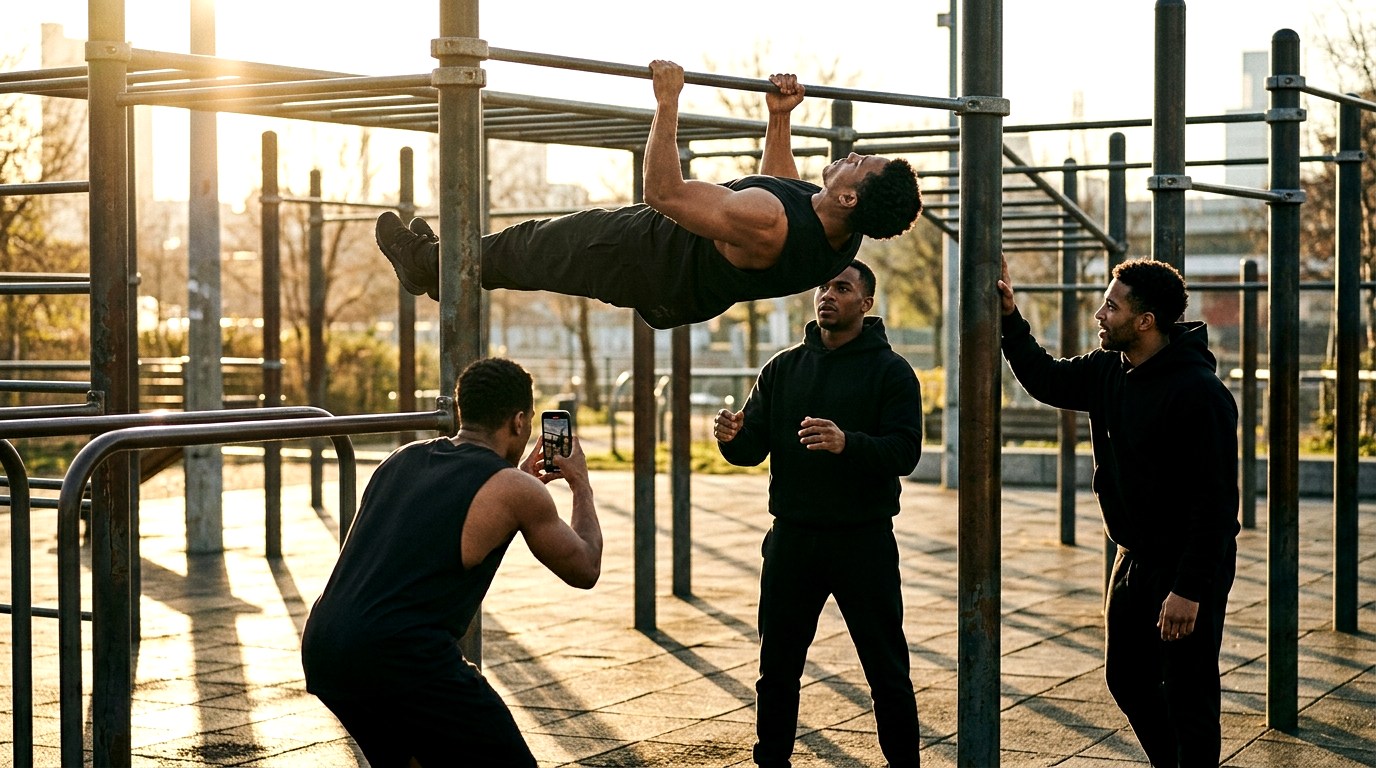
From Cold Park Warm-Ups to Platform Top Sets
Built for athletes who move their own bodyweight: pair our Fleece Zip-Up Boxy Hoodie ($61.94) and Unisex Oversized OG Crewneck ($39.94) with the raw-edge Anti Grav Cut-Off ($39.99).
The 28-Day Bar Blueprint: Step-by-Step 4-Week Training Plan
Reading about biomechanics won’t build a single rep unless you bring a clear plan to the bar. Below is your complete, easy-to-follow 4-Week Training Blueprint for 10 Calisthenics Myths That Hold You Back. First, click through Weeks 1 to 4 to see how your effort and reps change each week; then follow the 4 Weekly Workout Cards (Monday, Wednesday, Friday, Saturday) below.
How to Progress Across All 4 Weeks
Pick a progression or weight where every single rep looks textbook. Lower yourself for a full 3-second count and pause 1 second at the bottom.
Film your first and last set from the side at waist height so you have a Day 1 video to compare against Day 28.
Smooth & Controlled: Finish every set feeling like you could have done 3 more clean reps.
Keep the exact same exercise variation or weight as Week 1. Do not rush to a harder variation yet—earn more volume with identical form.
Rest a full 3 minutes between main sets so your last set is just as crisp as your first.
Solid Work: Finish each set with 2 clean reps left in the tank. Zero form breakdown.
Now that your joints and nervous system are grooved, increase the challenge slightly on your first 2 top sets while keeping strict lockout.
Prioritize 8 hours of sleep and high protein (1.6–2.0 g/kg bodyweight) to recover from peak week.
High Tension: Stop 1 rep short of failure. Never grind through elbow or shoulder pain.
Cut your sets by 50% on Monday and Wednesday so fatigue clears and your tendons supercompensate. Take Thursday and Friday off.
On Saturday (Day 28), warm up for 15 minutes and film your new Personal Best from the exact same angle as Day 1.
Fresh & Explosive: Easy sessions Mon/Wed so you feel weightless on Saturday’s test.
Exact Day-by-Day Session Cards
Upper-Body Strength & Skill
Wrist circles, 30s passive hang & 10 active scapular pulls
Handstand balance against wall/freestanding or L-Sit holds
Strict Pull-Ups paired with Parallel-Bar Dips (Rest 90s between moves)
Hollow Body Hold (lower back pressed flat) + Arch Hold
Legs, Core & Mobility
Deep resting squat hold (2 min) + Cossack lunges
Assisted Pistol Squats, Shrimp Squats, or Deep Split Squats
Nordic Hamstring Lowerings or Single-Leg Hip Thrusts
Pancake straddle fold + Pike compression leg lifts
Horizontal Control & Volume
Band shoulder dislocates, wrist rocks & 10 slow push-ups
Tuck Front Lever or Planche Lean with locked elbows
Bodyweight Ring/Bar Rows paired with Diamond or Pseudo-Planche Push-Ups
Two-Arm Dead Hang + 15 Band Face Pulls
Flow, Density & Prehab
5 Pull-Ups + 8 Dips + 10 Squats + 15s L-Sit (Rest 90s per round)
Crow pose, handstand balance, or bar flow transitions
Light wrist curls, reverse wrist curls & finger extensions
Relaxed dead hang and deep nasal breathing
Frequently Asked Questions
How many days per week should I run this 10 Calisthenics Myths That Hold You Back blueprint?
Four sessions per week (Monday, Wednesday, Friday, Saturday) gives you the ideal balance of practice frequency and tendon recovery. If your schedule is tight, perform Monday, Wednesday, and Friday (3 days/week) and keep Tuesday, Thursday, and weekends as active rest.
What if an exercise in the workout card is too hard or too easy for my current level?
Adjust the leverage, not the form. If you cannot hit the minimum reps with locked elbows and a smooth 3-second lowering phase, step back one variation (for example, move from Advanced Tuck to Tuck, or reduce dip-belt weight by 5 kg). If you hit the top of the rep range easily on all sets in Week 3, advance to the next variation in your next 4-week block.
Why do we cut sets in half during Week 4 instead of pushing harder?
Muscles recover in 48 to 72 hours, but tendons and elbow/shoulder connective tissues need every fourth week at lighter volume to finish laying down new collagen fibres (Kjaer et al., 2009; Bohm et al., 2015). Week 4 is where your body locks in the strength you built in Weeks 1–3.
What gear do I actually need in my bag for this 4-week block?
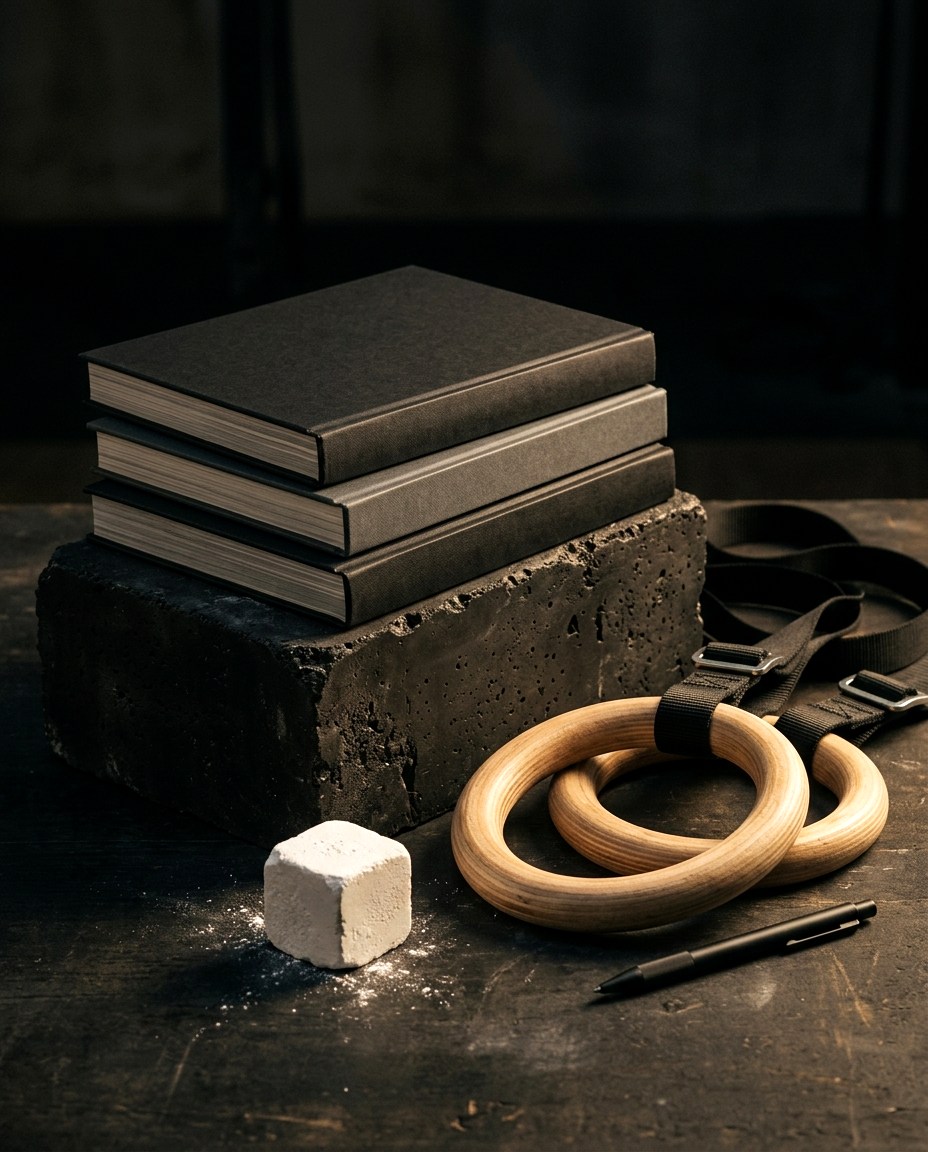
Keep it simple: liquid or block chalk for grip security, a notebook or phone timer to track your sets and 3-minute rests, wooden rings or parallettes if floor work bothers your wrists, and an unrestricted top like the Anti Grav Cut-off ($39.99) paired with a warm layer like the Fleece Zip-Up Boxy Hoodie ($61.94).
Sources: Kikuchi & Nakazato, 2017; Schoenfeld et al., 2017; Vispute et al., 2011; Watson et al., LIFTMOR, 2018; Fiatarone et al., JAMA, 1990.
Train in the club’s colours. Anti Gravity Club makes training apparel for people who move their own bodyweight. Shop the club
Leave a Reply