

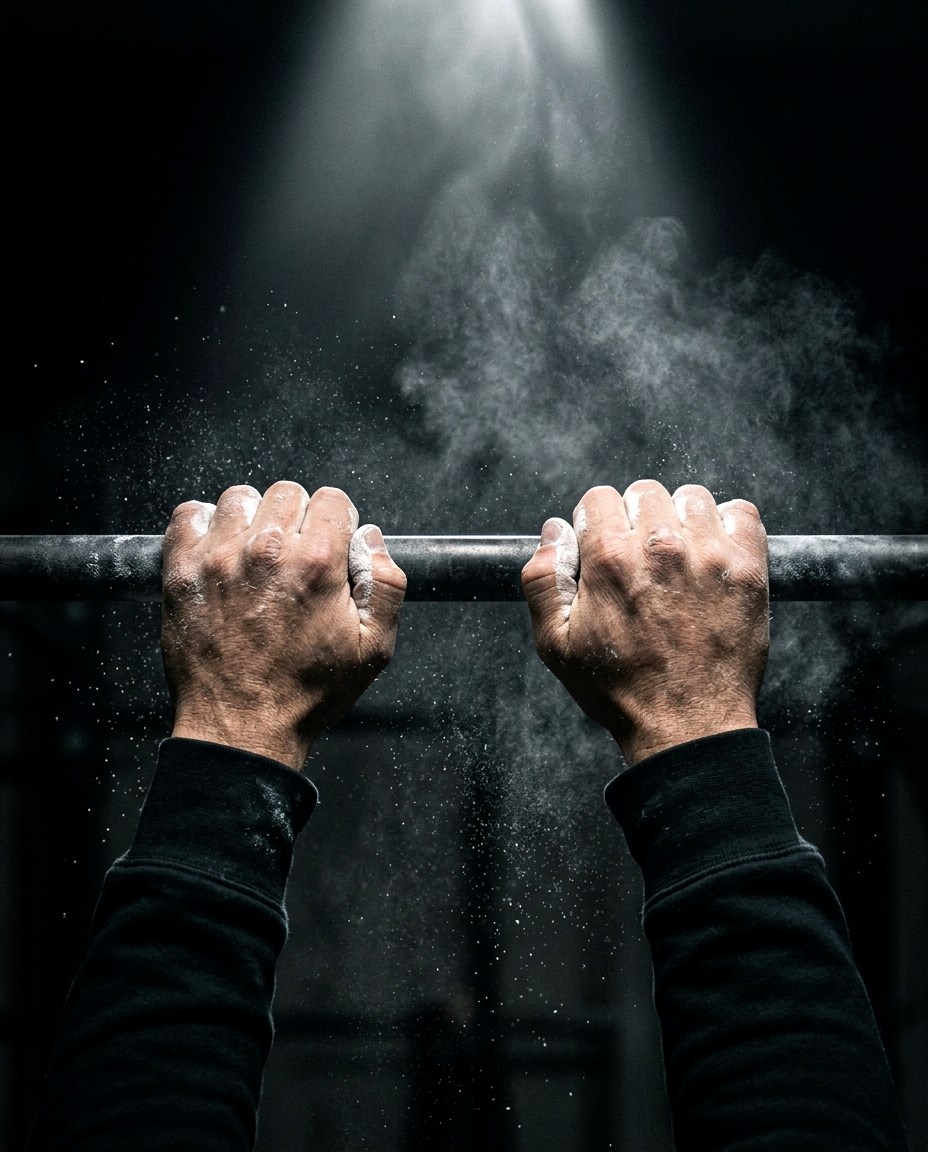
Every pull-up, every lever, every muscle-up and every freestyle release begins in the same place: your hands. You can have the back of a champion, but if your grip fails, the set is over. Grip is the most underrated strength in the sport.
- Core Takeaway: Real progress in grip comes from strict full-range reps, tendon patience, and logging every session in ink.
- The Science in Plain English: Muscles adapt in weeks, while tendons need structured 3-week build blocks followed by a Week 4 recovery deload.
- Put It Into Practice: Follow the interactive 28-Day Bar Blueprint below on Monday, Wednesday, Friday, and Saturday.
Grip is health
Grip strength says more about you than how long you can hang. In the PURE study, which followed nearly 140,000 adults across 17 countries, published in The Lancet in 2015, every 5 kg of lower grip strength was linked to a 16% higher risk of death from any cause. It predicted mortality better than blood pressure did. Strong hands are a sign of a strong body.
The kinds of grip
- Support grip: holding on for time. Hangs, levers, long freestyle sets.
- Crush grip: squeezing hard. It increases tension through the whole arm.
- Pinch grip: fingers against thumb. Builds the hand itself.
- The false grip: the wrist over the bar or ring, essential for strict muscle-ups on rings.
How to train it
Hang, a lot
Dead hangs build support grip and open the shoulders. Work towards one minute or more, then progress to one-arm hangs, assisted by the other hand at first.
Change the bar
Hang from a towel draped over the bar, or wrap the bar to make it thicker. Unfamiliar grips force the hand to work harder.
Squeeze with purpose
In every pull and hold, squeeze the bar as if you were trying to crush it. Tension in the hand spreads up the arm and into the shoulder, making the whole body more stable.
Train the other direction
Spread the fingers against resistance, such as a rubber band, to balance the hand and keep the elbows happy.
Look after your hands
Calluses protect you, until they get thick enough to tear. File them down regularly so they stay smooth and level with the skin. Keep your hands moisturised on rest days. Use chalk for heavy or sweaty sessions. A torn callus can cost you a week; a minute of care prevents it.
- Daily — a few minutes of hanging, spread across the day.
- Weekly — towel or thick-bar hangs, and one-arm hang progressions.
- Every set — squeeze the bar as if you meant it.
- Skin — file calluses, moisturise, chalk when it is heavy.
Hold on
The grip is where you meet the bar, and where the bar meets your body. Train it and every skill above it gets easier.
The anatomy of the forearm: extrinsic flexors, intrinsic hand muscles, and the false grip
Your hand is controlled by more than thirty muscles working in concert: the deep extrinsic flexors in the forearm—flexor digitorum profundus (FDP), which bends the distal fingertips, and flexor digitorum superficialis (FDS), which bends the middle phalanges—paired with the wrist flexors (flexor carpi radialis and flexor carpi ulnaris), the intrinsic thenar/hypothenar muscles of the palm, and the extensor digitorum on the back of the forearm that stabilizes the wrist under clamping loads.
When Leong et al. (2015) published the PURE study of 139,691 adults in The Lancet, they found that grip strength was a more powerful predictor of all-cause and cardiovascular mortality than systolic blood pressure—because grip strength integrates global neuromuscular integrity, vascular health and systemic vitality. On the bar, your grip is also the neural switch for your entire upper body: through hyper-irradiation, crushing the bar activates spinal interneurons that amplify force output in the rotator cuff, latissimus dorsi and core.
In high-rep endurance sets, a thumbless hook grip saves forearm energy; in heavy weighted pull-ups, muscle-ups and dynamic releases, wrap the thumb around the steel and crush it to prevent bar slip and maximize irradiation.
By resting the pisiform bone and ulnar heel of the palm on top of the ring or bar in full wrist flexion, you shorten the moment arm of the muscle-up transition and eliminate the dead zone between pull and dip.
Progress from a 60-second two-arm dead hang to uneven towel hangs, then 3-finger assists, then 10-to-30-second one-arm active hangs with the shoulder blade depressed.
Every 10 sets of heavy gripping should be balanced with 2–3 sets of high-rep finger extensions (rubber band expansions) and radial/ulnar wrist deviations to bulletproof the medial and lateral epicondyles.
The Park vs. Platform Reality Check: What Separates Real Progress From Ego
Ten-second social media clips only show the one lucky attempt filmed on fresh legs. Real calisthenics happens on a cold morning when nobody is watching, or on a competition platform when three referees are staring at your elbow lockout. Here is how the Anti Gravity Club standard compares to common park shortcuts in The Grip: Where Every Skill Begins:
| Training Habit | The Ego / Highlight-Reel Mistake | The Anti Gravity Club Standard | Result After 12 Months |
|---|---|---|---|
| Range of Motion | Stopping 2 inches short of a dead hang on pull-ups and cutting dips shallow | Dead stop at the bottom to chin/chest over bar; shoulder below elbow on every dip (ISF Rules v5.2) | Thicker muscle belly growth, bulletproof joints at full range, and competition-legal reps |
| Static Hold Quality | Holding a shaky 2-second progression with bent elbows and piked hips | Stacking 5–6 crisp sets of 6–8 seconds with locked triceps and squeezed glutes | Pain-free elbows and steady progression to straddle and full holds |
| Tracking Progress | Doing random circuits until tired with no record of reps, weights, or rest | Writing down Bodyweight + Belt Weight, sets, reps, and 3-minute rests in a logbook | Predictable strength gains every 4-week block with zero guesswork |
| Joint Recovery | Ignoring wrist or elbow tightness until an injury forces months off | 8-minute warm-up before every session and a lighter Week 4 deload every month | 52 unbroken weeks of training—the real secret behind elite calisthenics athletes |


Train Without Sleeve Drag: The Anti Grav Cut-Off ($39.99)
Standard t-shirt sleeves bind across the shoulders the moment your arms travel overhead into a dead hang, muscle-up, or handstand. Our heavyweight raw-edge Cut-Off clears the shoulder blade completely while protecting your waist under a dip belt.
The 28-Day Bar Blueprint: Step-by-Step 4-Week Training Plan
Reading about biomechanics won’t build a single rep unless you bring a clear plan to the bar. Below is your complete, easy-to-follow 4-Week Training Blueprint for The Grip: Where Every Skill Begins. First, click through Weeks 1 to 4 to see how your effort and reps change each week; then follow the 4 Weekly Workout Cards (Monday, Wednesday, Friday, Saturday) below.
How to Progress Across All 4 Weeks
Pick a progression or weight where every single rep looks textbook. Lower yourself for a full 3-second count and pause 1 second at the bottom.
Film your first and last set from the side at waist height so you have a Day 1 video to compare against Day 28.
Smooth & Controlled: Finish every set feeling like you could have done 3 more clean reps.
Keep the exact same exercise variation or weight as Week 1. Do not rush to a harder variation yet—earn more volume with identical form.
Rest a full 3 minutes between main sets so your last set is just as crisp as your first.
Solid Work: Finish each set with 2 clean reps left in the tank. Zero form breakdown.
Now that your joints and nervous system are grooved, increase the challenge slightly on your first 2 top sets while keeping strict lockout.
Prioritize 8 hours of sleep and high protein (1.6–2.0 g/kg bodyweight) to recover from peak week.
High Tension: Stop 1 rep short of failure. Never grind through elbow or shoulder pain.
Cut your sets by 50% on Monday and Wednesday so fatigue clears and your tendons supercompensate. Take Thursday and Friday off.
On Saturday (Day 28), warm up for 15 minutes and film your new Personal Best from the exact same angle as Day 1.
Fresh & Explosive: Easy sessions Mon/Wed so you feel weightless on Saturday’s test.
Exact Day-by-Day Session Cards
Explosive Skill & Heavy Pull
30s dead hang, 2×10 scapular pulls & wrist/forearm rotations
High Pull-Ups, Muscle-Up Transitions, or Front Lever Holds (Rest 3 min)
Strict Dead-Hang Pull-Ups (weighted or bodyweight; pause 1s at bottom)
Ring Pelicans / Supinated Curls + Finger-Band Extensions
Horizontal Rows & Slow Control
Active hangs, cat-cow spine waves & band pull-aparts
Tuck Front Lever Rows or Feet-Elevated Ring Rows (pause 1s at chest)
Full-Range Parallel-Bar Dips or Deficit Push-Ups
Strict Hanging Leg Raises (zero swing) + 20s L-Sit Hold
Bar Speed & Back Volume
2×5 scapular pulls + 2×3 explosive chest-to-bar pull-ups
Front/Back Lever, Human Flag, or Explosive Pulls (Rest 3 min)
Every minute on the minute: 3 to 5 strict Chin-Ups or Neutral Pull-Ups
Towel Hang, False-Grip Hang, or Thick-Bar Dead Hang
Legs, Mobility & Hand Care
Pistol Squat Progressions or Deep Step-Ups
Nordic Hamstring Curls or Glute-Ham Bridges
Skin-the-Cat mobility stretch + Jefferson Curls
Sand raised callus ridges flat with pumice stone & apply hand balm
Frequently Asked Questions
How many days per week should I run this The Grip: Where Every Skill Begins blueprint?
Four sessions per week (Monday, Wednesday, Friday, Saturday) gives you the ideal balance of practice frequency and tendon recovery. If your schedule is tight, perform Monday, Wednesday, and Friday (3 days/week) and keep Tuesday, Thursday, and weekends as active rest.
What if an exercise in the workout card is too hard or too easy for my current level?
Adjust the leverage, not the form. If you cannot hit the minimum reps with locked elbows and a smooth 3-second lowering phase, step back one variation (for example, move from Advanced Tuck to Tuck, or reduce dip-belt weight by 5 kg). If you hit the top of the rep range easily on all sets in Week 3, advance to the next variation in your next 4-week block.
Why do we cut sets in half during Week 4 instead of pushing harder?
Muscles recover in 48 to 72 hours, but tendons and elbow/shoulder connective tissues need every fourth week at lighter volume to finish laying down new collagen fibres (Kjaer et al., 2009; Bohm et al., 2015). Week 4 is where your body locks in the strength you built in Weeks 1–3.
What gear do I actually need in my bag for this 4-week block?
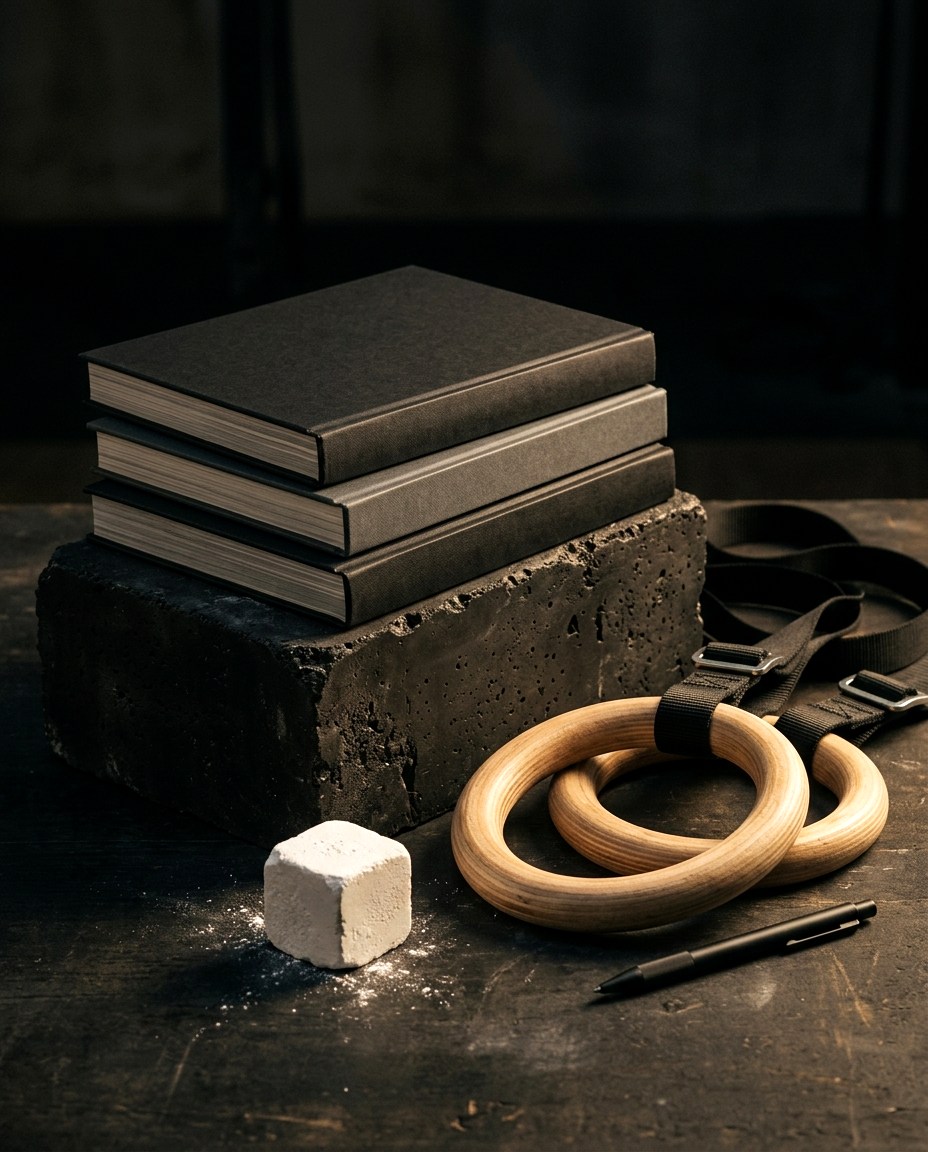
Keep it simple: liquid or block chalk for grip security, a notebook or phone timer to track your sets and 3-minute rests, wooden rings or parallettes if floor work bothers your wrists, and an unrestricted top like the Anti Grav Cut-off ($39.99) paired with a warm layer like the Fleece Zip-Up Boxy Hoodie ($61.94).
Strong hands.
Strong body.
Never let go.
Source: Leong et al., the PURE study, The Lancet, 2015. Nothing here is medical advice. Build up gradually, and see a qualified professional about pain that is sharp or lasts.
Train in the club’s colours. Anti Gravity Club makes training apparel for people who move their own bodyweight: heavyweight boxy hoodies, oversized crewnecks, raw-edge cut-offs and straight-leg sweats built for the bar and the street. Shop the club


Leave a Reply